Piano Lessons in Vancouver: A Family Guide to Starting at the Right Studio
If you are looking for piano lessons in Vancouver for your child — or for yourself — you have probably noticed that most studio websites say the same things. Patient teachers, a warm welcome, all ages welcome. What they rarely tell you is what a first lesson looks like, how much practice a beginner needs, or what it costs before you commit. Those are the details that decide whether lessons last, so this guide puts them first.
Music Star Learning Center has been teaching music in Burnaby since 2007, from our studio at Unit 200, 4789 Kingsway, across from Metropolis. Our piano lessons are one-to-one, for children and adults, in person or online — and if you are wondering how to start piano lessons in Vancouver, you do not need to buy a piano first. A keyboard or digital piano is plenty for a beginner. This guide covers the first lesson, the right age, practice, pricing, and choosing a teacher.
In this guide:
What Piano Lessons in Vancouver Actually Cover
The piano is where many musicians begin, because it lays out music so you can see it: low notes on the left, high notes on the right, and every note in its own place. That visible layout is why piano is often the first instrument families choose, and why good piano lessons in Vancouver spend as much time on reading and rhythm as they do on the pieces themselves. Our piano lessons in Vancouver are private, with one plan built around each student.
Piano lessons in Vancouver have to cover more than songs. Posture and hand position come first, because a tense wrist or a collapsed finger makes everything after it harder. Then comes reading: treble and bass clefs, note values, counting out loud. Rhythm games and simple scales build coordination, and short pieces give the student something real to play at home.
Why We Teach Beginners One on One
Families comparing piano lessons in Vancouver often ask why we do not run group piano classes for first-timers. The honest answer is that a beginner’s hands need watching: a thumb tucking under at the wrong moment, a wrist dropping, a finger drifting to the wrong key. In a group, a teacher cannot catch all of that, and a habit unnoticed for months can take a year to undo. Piano lessons in Vancouver let the teacher correct small things the moment they happen.
One-to-one teaching also means the music can follow the student’s taste. A child who loves movie themes can learn a simple version; an adult who grew up on the Beatles can work toward a song they want to play. Students practise the pieces they like and avoid the ones they do not, so piano lessons in Vancouver start with the student, not the syllabus.
What a Typical Weekly Lesson Looks Like
No two piano lessons in Vancouver are identical, but a 30-minute lesson for a newer student follows a steady rhythm, and longer lessons give each part more room. The table below is the shape most piano lessons follow in their first months. If you are still deciding, the shape of a single lesson tells you most of what you need to know.
| Part of the lesson | Roughly how long | What it builds |
|---|---|---|
| Warm-up and five-finger patterns | 5 minutes | Relaxed hands, steady touch |
| Scales or rhythm games | 5 to 7 minutes | Coordination and steady beat |
| Review last week’s piece | 8 to 10 minutes | Confidence and visible progress |
| New material or a tricky passage | 8 to 10 minutes | Reading skills and new technique |
| A plan for home practice | 2 to 3 minutes | Clear goals for the week |
That last step is easy to skip and matters most: students who leave knowing exactly what to practise arrive the next week having improved. If practice time worries you most, the practice section below gives realistic daily targets by age.
Your First Piano Lesson
The first piano lesson in Vancouver families book with us is a 30-minute trial, and it is deliberately low-pressure. The teacher’s job in that first meeting is to find out who the student is: their age, the music they like, whether they have touched a keyboard, and what they hope to get out of it. That is the point of a trial — to see whether teacher and student click before anyone commits to a weekly schedule.
Before the First Lesson
There is nothing to prepare. A keyboard or digital piano at home helps, but it is not required before the first lesson, and our teachers would rather a family wait for the right instrument than rush into the wrong one. If your child is the student, bring them — not just their schedule. A trial works best when the teacher meets the actual student and watches how they sit at the keys.
What the First Lesson Looks Like
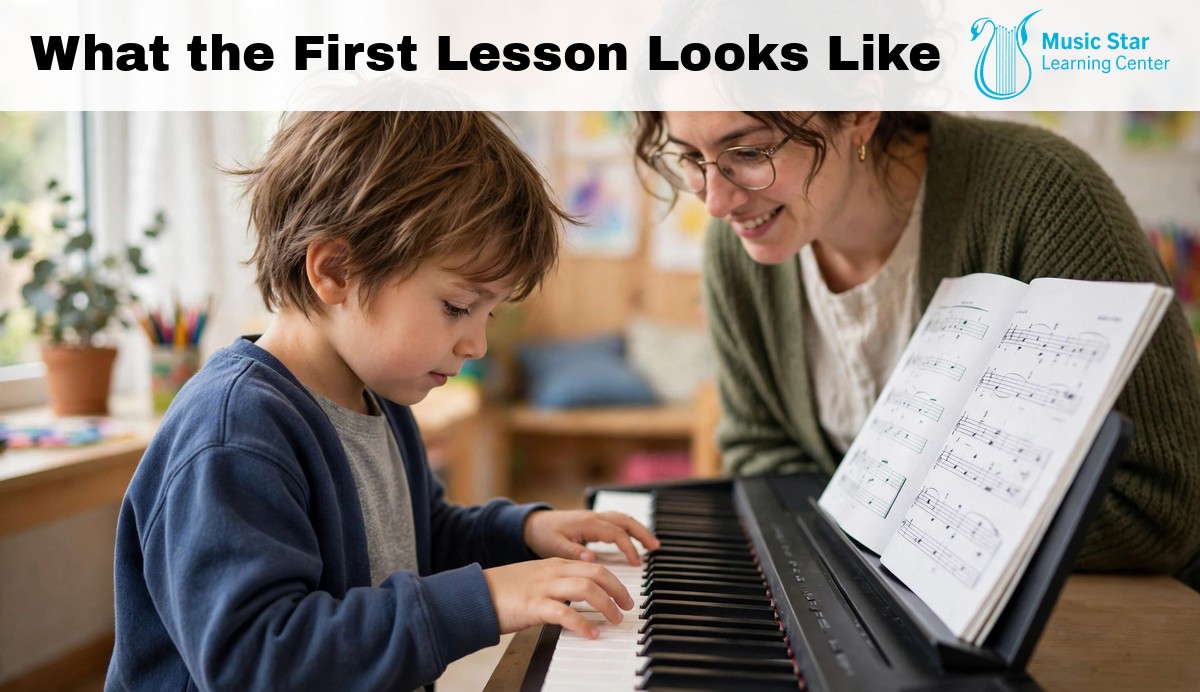
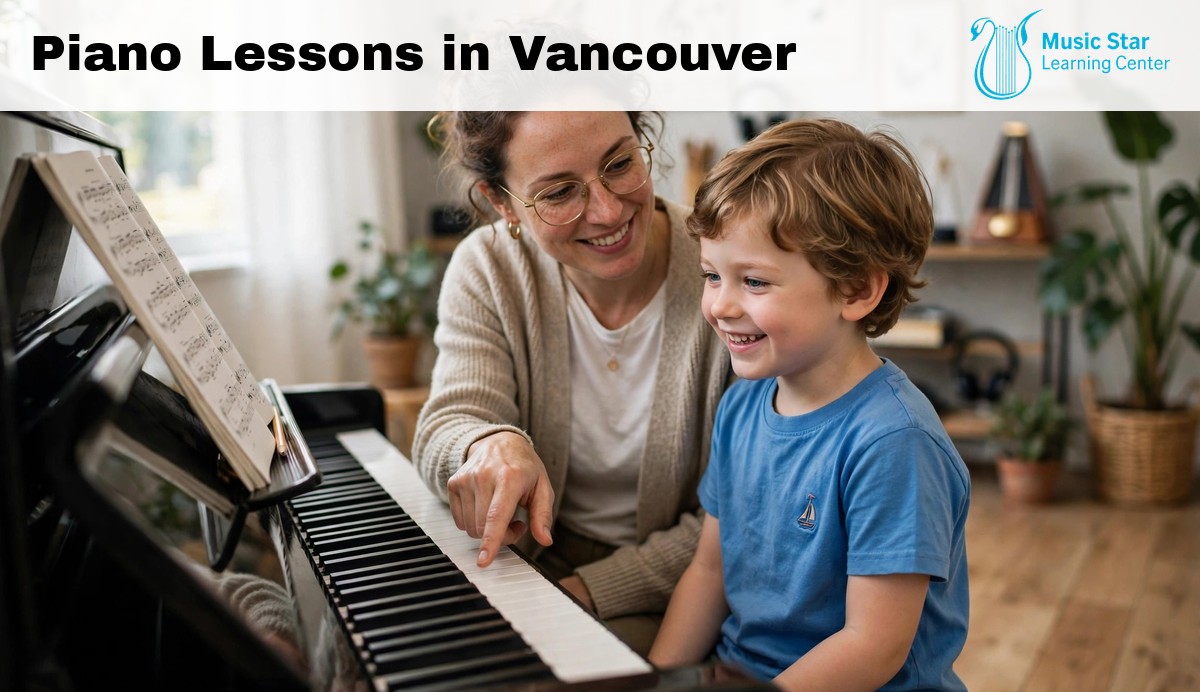
A first piano lesson usually starts away from the music stand. The teacher shows the student how to sit: bench height, feet flat, back straight but relaxed, arms loose. Then comes the keyboard — the pattern of white and black keys, the groups of two and three black keys that act as landmarks, and middle C. Most students play their first notes in that lesson, a simple five-finger pattern, and leave having made a sound on a real piano.
Bring a notebook if you like taking notes, and any sheet music you already own — plus your questions about scheduling, pricing, or RCM exams.
By the end of the lesson, the teacher will suggest a lesson length and a weekly time, and be honest if the timing is not right — if a young child would do better starting in a few months, the teacher will say so. A first piano lesson should end with a clear next step, not a sales pitch. Families who have compared piano lessons for beginners in Vancouver often say the trial is what decided them — not the brochure.
Meet the Teacher Behind Our Piano Lessons in Vancouver
Parents searching for piano lessons in Vancouver are usually trying to answer one question: does this person really know the instrument, and can they teach it to a child? A friendly website photo does not answer that; training, experience, and a lesson you can watch do.
Snow: Piano Diploma From Capilano University
Snow holds a Piano Diploma from Capilano University and studied piano at the University of British Columbia. She has more than four years of teaching experience and specialises in the RCM curriculum, combining practical skills and theory. Her lessons suit first-timers well, because the RCM path gives a new student a clear ladder of small, graded steps.
Piano lessons in Vancouver are never improvised from week to week. There is a sequence — posture, five-finger patterns, simple reading, first scales, first pieces — and Snow can say exactly where a student is on it and what comes next.
Questions to Ask Before You Book
Whichever teacher you consider, a short conversation or a trial lesson will tell you a lot. Here is what to ask:
A good teacher will answer all six without hesitation. If a studio dodges the first question, that tells you something too.
The Right Age to Start Piano Lessons in Vancouver
We welcome piano students from age four, and we teach adults who have never touched an instrument. Piano works well from an early age because the keys are laid out in front of the student — nothing to hold up, tune, or squeeze — but readiness matters more than the number on a birthday cake. Piano lessons in Vancouver are built around the same idea: start where you are, and move at a pace your week can hold.
Piano Lessons for Kids in Vancouver: Starting Young
Most families looking at piano lessons for kids in Vancouver have a child between four and ten. For the youngest, lessons are shorter and more playful: finding middle C, clapping rhythms, sitting comfortably at the keys. By seven or eight, most children can read notes and play simple pieces. Parents help most by keeping home practice short, regular, and calm. If you are still deciding on timing, our guide to the best age to start piano lessons for kids covers readiness in more detail.
Signs Your Child Is Ready
If your child shows two or three of these, book a trial lesson. A teacher can tell more from twenty minutes at the keyboard than any checklist can.
Teens and Adult Beginners
It is never too late to start: adults follow instructions quickly and pick up theory fast. The trade-off is time, so we plan lessons around what is realistic. Teens who already play another instrument move quickly, since reading and rhythm carry over. And if you are an adult wondering how to start piano lessons in Vancouver after years of thinking about it, book one trial lesson: the hardest part is usually the booking, not the playing. That is true for piano lessons for adults in Vancouver as well — one-to-one, at your pace, with a teacher who adjusts to you.
How Practice Works in Piano Lessons in Vancouver
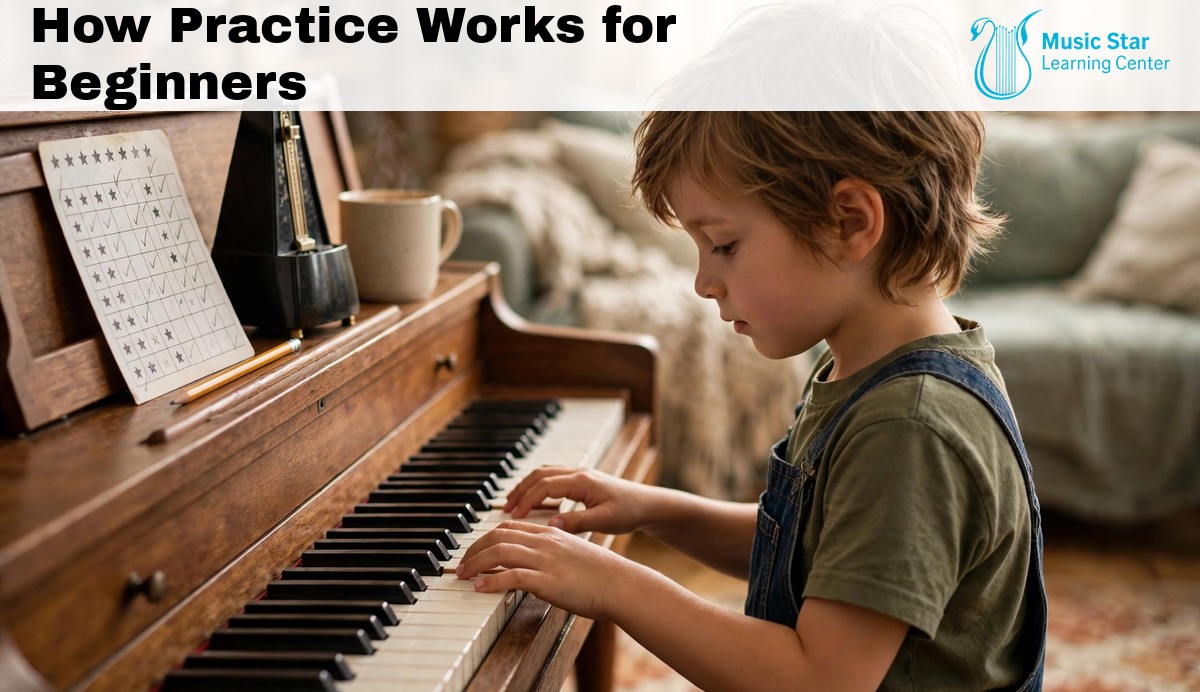
Piano lessons in Vancouver are only half of learning an instrument. What happens between lessons decides how fast a beginner improves — the part parents worry about most. The good news is that practice at home does not need to be long — it needs to be regular. Ten focused minutes, five days a week, will beat an hour crammed in on Sunday every time.
How Much Practice Is Enough?
The right amount depends on age and lesson length, and it grows as the student grows. The table below is a realistic starting point. For a deeper guide, our article on how often should kids practice piano covers routines, motivation, and what to do on a week when nothing goes to plan.
| Student | A good daily target | How to keep it going |
|---|---|---|
| Ages 4 to 6 | 10 minutes, 4 to 5 days a week | Keep it playful, sit nearby |
| Ages 7 to 9 | 15 minutes, 5 days a week | Same time each day, short and steady |
| Ages 10 to 12 | 20 minutes, 5 days a week | Let them choose the closing piece |
| Teens and adults | 20 to 30 minutes, 4 to 5 days a week | Fit it around work and school, not against them |
Notice what the table does not say: not an hour a day. Beginners who practise a little, often, build the habit that carries them through the harder months.
Making Practice Stick
Three small habits make more difference than any practice chart. First, fix a time — straight after school, or right after dinner — so practice is part of the day. Second, keep the piano or keyboard visible and uncovered. Third, end every session with a piece the student likes. Students who finish on a win come back the next day willingly — as true for piano lessons for adults in Vancouver as for a six-year-old.
What Piano Lessons in Vancouver Cost
Pricing for piano lessons varies widely, and many studios only share it after a phone call. We would rather show you exactly what piano lessons in Vancouver cost, with nothing added later. The same rates apply to children and adults, and the same three lengths cover every beginner.
Choosing the Right Lesson Length
| Lesson type | Length | Price |
|---|---|---|
| Private Piano Lesson | 30 minutes | $35 |
| Private Piano Lesson | 45 minutes | $47 |
| Private Piano Lesson | 60 minutes | $62 |
| RCM Piano Exam Prep, Level 3–5 | 4 x 45-minute sessions | $200 |
| RCM Piano Exam Prep, Level 5–8 | 4 x 60-minute sessions | $260 |
| RCM Piano Exam Prep, Level 8–10 | 4 x 60-minute sessions | $300 |
Prices are a starting point, not a quote — contact Music Star Learning Center for your exact price.
Most beginners start at 30 minutes, which matches a young attention span. Adults and older children often settle into 45 minutes once practice becomes a habit, and 60 minutes suits students working toward an RCM exam. Piano lessons for beginners in Vancouver are priced the same as every other instrument we teach, so the choice is about time, not cost.
RCM Exam Preparation
For students who like clear goals, the Royal Conservatory of Music Certificate Program offers a structured path from the earliest levels to advanced diplomas. Each level sets requirements for repertoire, scales and arpeggios, etudes, ear training, and sight reading; exams are marked out of 100, with 60 as the pass mark. The RCM publishes the official Royal Conservatory of Music piano syllabus and exam requirements online.
Our exam packages follow those requirements in blocks of four sessions. Exam preparation is available for piano from Level 3 to Level 10, with packages from $200 per four-session block.
Is an RCM Exam Right for a Beginner?
Exams are optional, and no beginner needs one in year one. They suit students motivated by milestones, and teens who may want credentials later. Playing purely for enjoyment is fine too — and many of our longest-staying students have never taken an exam.
How to Choose Piano Lessons
A search from a Vancouver address turns up independent teachers, academies, music stores with lesson rooms, and online marketplaces. Each can work. The trick is to compare piano lessons in Vancouver on what actually predicts whether a student sticks with it — and to visit a trial lesson before deciding. That is the honest way to work out how to start piano lessons in Vancouver: shortlist two or three studios and let the trial decide.
| What to compare | What to look for | Why it matters |
|---|---|---|
| Teacher training | Verifiable qualifications and teaching experience | Early habits are shaped by whoever corrects them |
| Lesson format | Private lessons for beginners, ensemble playing later | Piano needs individual correction in the early months |
| Pricing | Rates you can see before you call | Easier to plan for a full year of lessons |
| Trial lesson | A short first lesson before committing | Lets your child meet the teacher in a low-pressure way |
Comparing teachers on qualifications alone misses half the picture, because teaching style matters as much — and the only way to judge it is to watch piano lessons in Vancouver. Ask each studio whether the trial is one on one — some are run in groups. Piano lessons for adults in Vancouver are worth comparing the same way: sit in on a trial, watch how the teacher corrects, and trust what you see.
Why Travel Time Matters More Than You Think
Distance is one of the most common reasons families stop piano lessons in Vancouver. A 20-minute trip feels fine in September and different in a dark, wet February. When you shortlist piano lessons in Vancouver, check the route at the time of day you would actually travel. The piano lessons in Vancouver families stick with for years are always the ones that fit easily into the week.
Getting to Our Studio From Vancouver
Our studio is at Unit 200, 4789 Kingsway in Burnaby, in the Centrepoint building across from Metropolis at Metrotown. Families looking for piano lessons in Burnaby can reach us easily — and from Vancouver, Coquitlam, or New Westminster, the SkyTrain makes it a straightforward trip.
By SkyTrain, Bus or Car
Metrotown Station on the Expo Line is a five-minute walk from the building, with the Metrotown bus loop right beside it. Families from Downtown Vancouver, East Vancouver, and much of Burnaby can ride in without changing trains. Kingsway runs between Metrotown and Downtown Vancouver, so driving in is straightforward.
What Vancouver Families Say
We would rather you hear it from other parents than from us. You can read reviews from Vancouver families on our Google Business Profile, where parents describe their teachers and what the first months were really like. Reading a handful before choosing piano lessons for beginners in Vancouver is the quickest way to judge any studio, including ours.
Conclusion
Choosing piano lessons in Vancouver comes down to four honest questions. Is the teacher genuinely qualified? Is the format right for a beginner? Are the prices clear? Can your family get there every week without a battle? If a studio answers all four plainly, you are in good hands.
Here, those answers are piano lessons in Vancouver — private, with a teacher who holds a Piano Diploma from Capilano University, published pricing from $35, piano lessons for kids in Vancouver that start with a trial rather than a term, and a studio a short SkyTrain ride from much of the city. That is the kind of lesson families stay with for years. The next step is simple: book a 30-minute trial lesson and meet the teacher. And if you are still weighing how to start piano lessons in Vancouver, that trial is the best way to find out.