If you’re a parent in Burnaby, you’ve probably asked yourself this question about a dozen times. You’ve just signed your little one up for Piano Lessons for Kids, or you’re thinking about it. Then comes the inevitable worry: “Are we wasting our money if they quit in three months?”
Honestly, I get it. We live in a world of instant gratification. But here’s the thing learning piano isn’t a TikTok video. It doesn’t go viral overnight. It’s more like planting a garden. You water it, you wait, and just when you think nothing is happening, a little green shoot pops up.
Let’s be real. How long does it take for kids to learn piano? The truthful answer isn’t a single number. It depends on what you mean by “learn.” Are we talking about playing “Twinkle, Twinkle, Little Star” without crying? Or performing a Bach Minuet at a recital?
In this guide, we’re going to break down a realistic timeline. We’ll look at the stages, the struggles, and the glorious little victories. By the end, you’ll know exactly what to expect for your child in Burnaby.
Why Is Learning Piano Beneficial for Kids?
Before we dive into the timeline, let’s address the elephant in the room. Why bother? If it takes years, is it worth it?
Absolutely. And I don’t just mean because they’ll look good on a university application.
The Impact of Learning Music on Cognitive and Emotional Development
Did you know that playing piano is basically a full-body workout for the brain? It’s true. When a kid sits at a keyboard, they are reading music (visual), moving their hands (motor), counting beats (mathematical), and listening for pitch (auditory). All at the same time.
Let’s not forget the emotional side. Have you ever seen a frustrated kid finally nail a difficult passage? The way their face lights up? That’s resilience being built in real time. Piano teaches kids that struggle leads to mastery. It’s a lesson no school textbook can replicate.
Long-Term Benefits of Piano Lessons in Childhood
I’ve spoken to a lot of adults who quit piano at age ten and now regret it. But the ones who stuck with it for even just two or three years? They have incredible focus. They listen better. They understand that discipline isn’t punishment; it’s a tool.
We’re talking about improved memory, better language skills, and even higher math scores. Honestly, if you’re looking for a Music School in Burnaby, you’re not just signing up for a hobby. You’re signing up for cognitive armour.
Stages of Piano Learning for Kids
To understand the timeline, you have to understand the journey. Learning piano is not a straight line. It’s a series of plateaus and jumps.
Early Stage: Getting Familiar with the Piano and Notes
This is the “discovery phase.” Think ages 4 to 6 mostly. The piano is a big, noisy toy at first. That’s fine! In this stage, we aren’t worried about perfection. We care about curiosity.
Kids learn finger numbers. Where is Middle C? Black keys versus white keys. They might play a song using just one finger (gasp!) and that’s okay. The goal here is to make the instrument a friend, not a foe.
Intermediate Stage: Developing Technique and Basic Skills
Now we’re cooking. This usually hits 6 to 12 months in. At this stage, the child can read basic notes on the staff. They understand rhythm quarters, halves, whole notes. They start using both hands together (which feels like patting your head and rubbing your belly, honestly).
They’ll play simplified versions of “Ode to Joy” or “Jingle Bells.” It won’t be concert hall ready, but you’ll recognize the tune. This is where a lot of parents think, “Wow, they’re actually doing it!”
Advanced Stage: Mastering Complex Pieces and Gaining Proficiency
This is the three-to-five-year mark. At this level, kids are playing real literature. Think Clementi sonatinas, easy Chopin, or pop arrangements with actual chords. They can sight-read easier pieces and understand dynamics (loud, soft, crescendo).
They aren’t just pressing keys anymore. They are interpreting music. This is where the magic happens. And this is where How long does it take for kids to learn piano becomes a different question. Because at this point, they know piano. Now they just refine.
Factors That Affect the Timeline of Learning Piano
Here’s where we need a reality check. Every child is different. You cannot compare little Sarah down the street who practices two hours a day to your son who fights you over five minutes.
Several variables make the timeline shift.
Age and Initial Skills of the Child
A four-year-old has tiny hands and a short attention span. You cannot rush finger dexterity. That takes biology. A ten-year-old, however, has better motor control and logical thinking. They will progress through the early stage much faster.
But here’s the trade-off. The younger they start, the more natural the skills become. They grow with the instrument. An older beginner might learn the notes quicker, but they often struggle with rhythm because their brain wants to overcomplicate it.
Frequency and Duration of Practice Sessions
Let’s do some quick math. If your child practices 15 minutes a day versus an hour once a week? The daily practice wins. No contest.
How long does it take for kids to learn piano when they practice daily? About three times faster than a child who crams before their lesson. Muscles have memory. The brain needs sleep to solidify those neural pathways. Consistent, short sessions are the cheat code.
The Role of Professional Teaching and Teaching Style
You wouldn’t learn to drive from a friend who crashes a lot, right? Same goes for piano.
A Great Piano Teacher doesn’t just assign pages from a method book. They adjust. They notice when a kid is bored and throw in a Frozen song. They spot tension in the wrist before it becomes a bad habit. A mediocre teacher follows a script. A great teacher follows the child.
If you want to Teach Kids Piano effectively, you need someone who understands child psychology, not just music theory.
A Typical Timeline for Learning Piano Based on Age
So, let’s put some rough numbers on the board. Take these with a grain of salt. They assume weekly lessons and daily practice (mostly).
Ages 4 to 6: Starting with Basic Concepts
- Months 0-3: Finding Middle C. Finger wiggles. Clapping rhythms. They learn that the black keys come in groups of twos and threes.
- Months 3-8: Playing very simple songs with one hand. Reading off finger numbers, not necessarily real notes.
- Months 8-12: Introduction of the musical alphabet. They can play “Hot Cross Buns” with three notes.
Realistic goal after 1 year: Can play a few short songs for Grandma. Needs help counting.
At this age, you are not raising a concert pianist. You are raising a music lover. Patience is key.
Ages 7 to 10: Progressing with Technique and Simple Pieces
This is the golden age for starting piano, in my opinion. Their hands are stronger. They can read. They understand cause and effect.
- Months 0-6: Rapid progress through a method book (like Faber or Alfred). They master C position, G position. Hands separate, then together.
- Months 6-12: Scales! Just C major and G major. They can play simple arrangements of pop songs. They start using a metronome.
- Year 2: Playing hands together with confidence. Reading both treble and bass clef. Learning chords. They can play “Amazing Grace” or a simplified “Let It Go.”
- Realistic goal after 2 years: They can sit down and play a recognizable piece from start to finish with steady rhythm.
Ages 11 and Up: Performance and Advanced Skills Development
Tweens and teens have a massive advantage: self-awareness. They can critique themselves.
- Months 0-6: Because they understand theory faster, they fly through basic reading. However, they may struggle with finger independence because they started later.
- Year 1: Playing intermediate repertoire. Hanon exercises for finger strength. Introduction to major and minor scales.
- Year 2 – 3: Playing advanced classical or jazz. They can read lead sheets. They understand phrasing and pedalling. At this point, How long does it take for kids to learn piano has an answer: about two years to be competent, a lifetime to master.
- Realistic goal after 3 years: They can play a Grade 3 or 4 RCM (Royal Conservatory of Music) piece with expression.
How to Accelerate Your Child’s Piano Learning
We all want the shortcut. I won’t lie there are no magic wands. But there are smarter ways to work.
The Importance of Regular and Effective Practice
Ten minutes of focused practice beats an hour of unfocused noodling. Every single time.
Break it down: Warm-up (scales), review old songs (confidence boost), work on the hard spot (just two bars), then fun song (reward). That’s a perfect 15-minute session.
Here’s a hot tip. Don’t let them play the song from the beginning every single time. They will play the easy part perfectly and crash at the hard part. Instead, start at the hard part. Isolate it. Drill it. This is how pros practice.
How to Keep Your Child Motivated to Learn Piano
Motivation is fleeting. Discipline is better. But for kids, you have to make it fun.
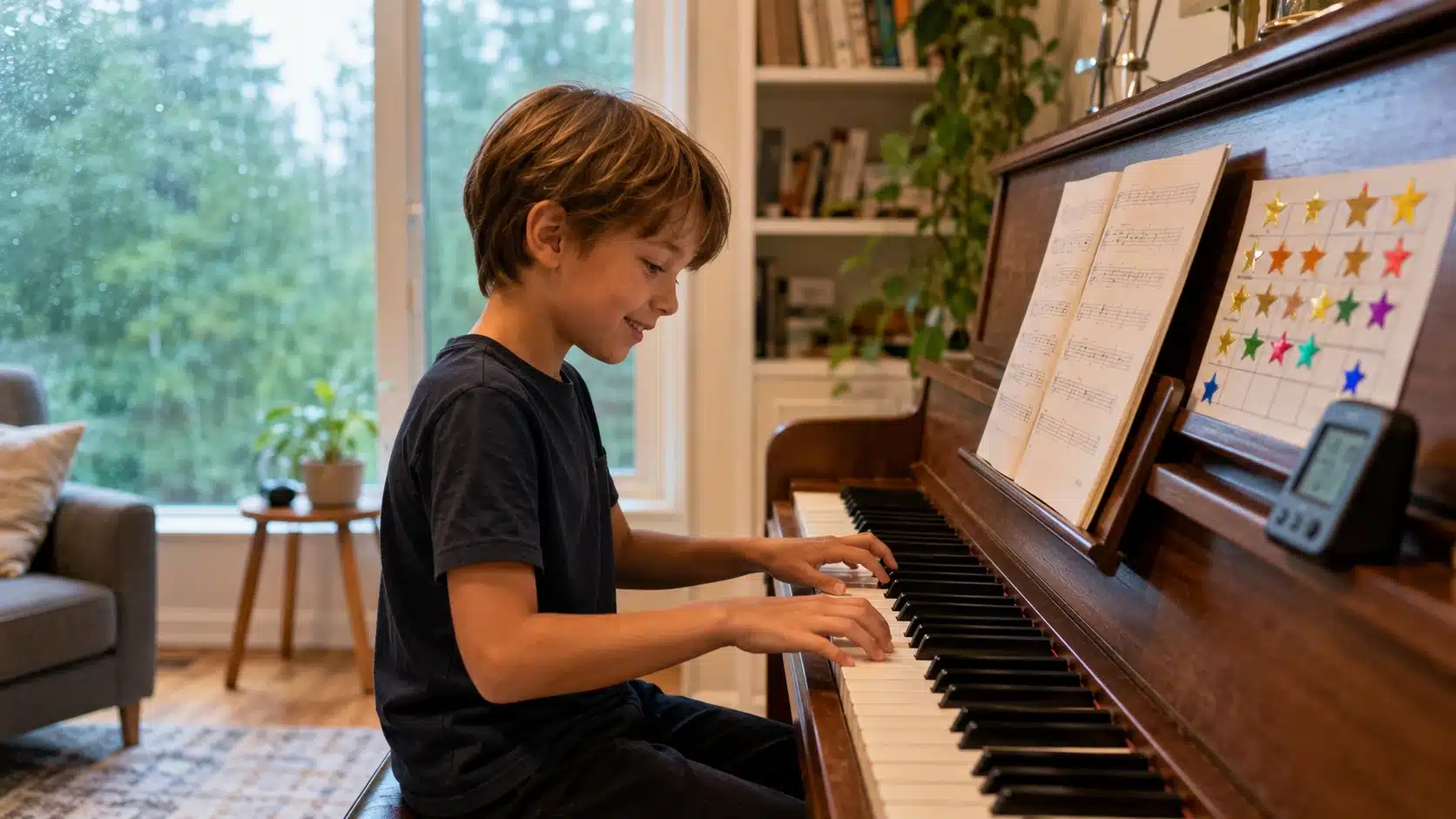
Create a sticker chart. Offer “piano bucks” for 5 days of practice that they can cash in for a small toy. Let them learn a terrible pop song they love (even if it’s not classical). Seriously, if they want to play “Baby Shark” on repeat, let them. Engagement is the goal.
And please, please don’t over-criticize. If you correct every single finger, they will hate it. Pick one thing per day. “Today, let’s just focus on keeping your thumb curved.” That’s it.
Common Challenges and Solutions in Piano Learning
You will hit a wall. It’s not a bug; it’s a feature.
When Your Child Feels Progress Is Slow
Have you ever heard of the “practice dip”? It’s when you practice a lot, but you sound worse for a few days. That’s actually your brain rewiring. It’s a sign that growth is about to happen.
Tell your kid, “The plateau means you’re about to jump up.” Show them a video of themselves from three months ago. They will be shocked at how far they’ve come. We forget our wins so easily.
Effective Solutions for Dealing with Fatigue and Boredom
Boredom is the enemy of Kids Practice Piano habits.
If they are tired, switch it up. Don’t play the acoustic piano. Draw notes on a whiteboard. Clap rhythms on a drum. Listen to a famous pianist on YouTube and ask, “Do you like how fast they played that?”
Change the environment. Sometimes, moving the keyboard to the living room or using a different coloured pen on their sheet music breaks the monotony. If you’re searching for piano lessons near me, find a teacher who uses games. A good studio uses flashcards, duets, and rhythm dice.
For Burnaby parents, look for a studio that understands this. The weather here can be gloomy. A warm, encouraging teacher makes all the difference when the rain is pounding on the windows and your kid just wants to watch Netflix.
What Does “Success” Actually Look Like?
Let’s reframe the question. Instead of asking How long does it take for kids to learn piano, ask: What do I want my child to get out of this?
- If success means winning a competition? You’re looking at 5-7 years of serious, daily practice and a very specific mentor.
- If success means playing “Happy Birthday” at a family party? Many kids can do that after 8-12 months.
- If success means being able to sit down and play for their own enjoyment as a teenager? That’s about 2-3 years of consistent work.
Honestly, the real success is the resilience. It’s watching your child fail at a measure, take a deep breath, and try again. That is the gift of music. The ability to play piano is just the cherry on top.
Conclusion
So, let’s wrap this up. How long does it take for kids to learn piano? To play basic songs with both hands? Roughly 6 to 12 months with consistent weekly lessons and daily short practices. To play intermediate repertoire confidently? Plan on 2 to 3 years. To reach a “lifetime” hobby level where they can learn songs on their own? 3 to 5 years.
Don’t let the timeline scare you. Every single minute spent at that piano is building a smarter, more patient, more creative human being. The time will pass anyway. Wouldn’t you rather have a child who can play a beautiful Chopin nocturne at the end of it?
The best time to start was five years ago. The second best time is today.
Ready to Start Your Child’s Piano Journey in Burnaby?
You don’t have to figure this out alone. Whether your child is a curious four-year-old or a motivated teenager, the right guidance makes all the difference.
At Music Star Learning Center, we specialize in Piano Lessons for Kids that actually keep them engaged. We use games, modern songs, and proven techniques to move past the boring stuff and into real playing. If you’ve been looking for music schools near me in Burnaby, your search is over.
Read our Google Maps reviews and find us locally:
Search for piano lessons in Burnaby on Google Maps or click here to leave a review and see our direction: [Music Star Learning Center on Google Maps].
Don’t let another week slip away. Give your child the gift of music. Contact us today to book your first Piano Lesson for Kids and let’s make some noise beautiful noise together.